 Jun 03, 2026
How Much Does Tree Removal Cost in Honolulu in 2026?
If you have been searching for a straightforward answer and every website you land on gives you a different number, that is not a mistake. Tree removal pricing in Honolulu genuinely varies that much, and there are real, logical reasons behind every dollar. This guide breaks it all down so you know exactly what drives the cost, what to expect on your property, and how to avoid overpaying.
What the Average Honolulu Homeowner Actually Pays
Most homeowners on Oahu pay somewhere between $793 and $1,400 for a standard tree removal job. Data from Manta puts the Honolulu County average between $793 and $1,067, while HomeBlue cites an overall average closer to $1,400 with a range of $500 to $2,300. For a three-person professional crew, labor alone runs approximately $250 to $320 per hour depending on the complexity of the work.
Here is a general breakdown by tree size to give you a working budget before you call anyone:
Small trees (under 30 feet): $300 to $700 Medium trees (30 to 60 feet): $700 to $1,500 Large trees (60 feet and above): $1,500 to $2,300 or more Crane-assisted or complex removals: $1,500 and up, often significantly higher Palm or coconut tree removal: $200 to $900 depending on height
Stump grinding, which is almost always a separate line item, adds another $82 to $167 for a medium stump in Honolulu according to Manta's local cost data. Some companies price stump removal by the square foot, with rates around $180 per square foot being reported by local contractors here on Oahu.
Limb removal or hauling, if not included in the base quote, can tack on $50 to $75 per load or more.
Why Honolulu Tree Removal Costs More Than the National Average
Hawaii is not the mainland, and tree service pricing reflects that reality. Several structural factors push costs higher here than what you might read in a general national guide.
Imported equipment and fuel costs. Every piece of heavy machinery used in Honolulu, from stump grinders to crane trucks, arrived on a shipping container. Parts, maintenance, and fuel carry that same island premium.
Higher cost of living. Labor in Hawaii is simply more expensive. Skilled arborists, climbers, and ground crew earn wages that reflect the state's cost of living, which ranks among the highest in the nation.
Specialized permitting requirements. Honolulu has some of the most detailed tree protection ordinances in the country, including the City and County of Honolulu's Exceptional Tree Program, overseen by the Arborist Advisory Committee and the Department of Parks and Recreation's Division of Urban Forestry. Navigating these regulations takes time, and time costs money.
Unique species challenges. Trees like monkeypod, banyan, African tulip, albizia, and kiawe have root structures and growth patterns that require specific knowledge and technique. A licensed ISA-certified arborist here understands those nuances in ways that a general tree cutter from the mainland simply does not.
Coconut Rhinoceros Beetle complications. Since CRB infestations were first detected on Oahu in 2013, an increasing number of coconut palm removals involve infected trees that require additional handling care to prevent the spread of breeding material. The City and County of Honolulu has already removed over a hundred CRB-damaged palms across the island. For private homeowners, this beetle issue can add complexity to a job that might otherwise be straightforward.
The 8 Biggest Factors That Affect Your Tree Removal Cost in Honolulu
1. Tree Height and Size
This is the single biggest pricing variable. A 20-foot ornamental tree in a Kaimuki front yard is a fundamentally different job than a 70-foot monkeypod in Manoa. More height means more sectional cuts, more rigging time, more debris to haul, and a longer crew day.
2. Accessibility of the Property
Trees growing in open front yards with direct street access are easier and cheaper to remove. Trees tucked behind fences, on steep hillside lots in areas like Nuuanu or Tantalus, or surrounded by tight structures require more setup, more precision, and often specialized rigging techniques. Difficult access routinely adds 7 to 15 percent to the base job cost.
3. Proximity to Power Lines and Structures
Any tree near active HECO utility lines requires additional coordination and safety protocol. In some cases the tree service must work directly with Hawaiian Electric Company to de-energize or protect lines before cutting begins. Trees overhanging roofs, driveways, pools, or neighboring structures require sectional felling, where the tree comes down in controlled pieces rather than in one fell cut, which adds both time and labor cost.
4. Tree Species and Root Complexity
Certain species that are common in Honolulu are genuinely harder to remove than others. Banyan trees have aerial root systems that spread far beyond the visible canopy. Kiawe has dense, interlocking root structures and thorned wood that slows the work down. African tulip trees, which are classified as invasive in Hawaii, often grow rapidly into utility lines and neighboring properties, creating removal complexity. Your arborist will factor species into the quote.
5. Condition of the Tree
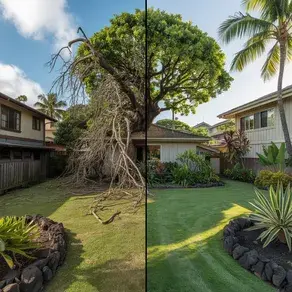
A healthy, structurally sound tree is more predictable to remove. A dead, diseased, or severely storm-damaged tree is not. Decayed wood does not behave like live wood when it is being sectioned and lowered, and crews have to work more slowly and carefully to avoid unpredictable breaks. Heavily compromised trees cost more to remove safely.
6. Whether a Crane Is Required
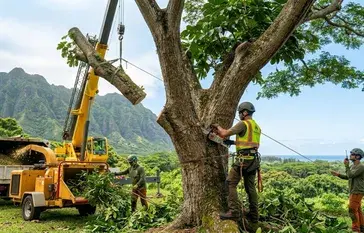
Crane tree removal is a specialized service used when a tree is too large, too tall, or too close to a structure to be brought down any other way. On Oahu, crane jobs start at approximately $1,500 and frequently run higher based on the crane operator's time and the complexity of the lift. This is not a cost you can cut corners on. Our crane tree removal service in Honolulu uses heavy-duty machinery to extract massive sections over rooflines with zero impact to the surrounding property.
7. Permit Requirements
Not every tree removal in Honolulu requires a permit, but some absolutely do. Trees designated as exceptional by the City and County of Honolulu are protected under the Exceptional Tree Act passed in 1975, and removing one without prior City Council approval can result in fines up to $1,000. If your tree falls into a protected category, permit handling adds time to the project timeline and may add to the administrative cost of the job. A reputable contractor handles this for you and includes it in the quote.
8. Emergency vs. Scheduled Service
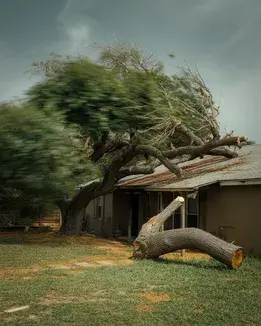
Timing matters more than most people expect. A tree removal scheduled two weeks out during a slow period will almost always cost less than the same job called in at midnight after a storm. Emergency surcharges are standard across the industry and reflect the real cost of mobilizing a crew, equipment, and a crane at short notice. If you have a downed or hazardous tree that poses an immediate threat to your home, vehicle, or family, do not wait. Our 24/7 emergency tree removal service in Honolulu is available around the clock for exactly these situations.
What Does a Tree Removal Quote in Honolulu Include?
Before you sign anything, it is worth knowing what a complete quote should cover. A thorough estimate from a licensed and insured Honolulu tree service will typically include the following line items:
Safe felling or sectional removal of the tree from crown to base Brush removal and chipping of all limbs and smaller branches Hauling away of debris, logs, and wood material from the site Site cleanup so the property is left clean at the end of the job
Items that are commonly quoted separately include stump grinding, stump removal, limb-only removal if you want to keep the wood, and permit fees if applicable. Always ask for a fully itemized written quote before work begins so there are no surprises on the invoice.
One thing that separates reputable tree companies from fly-by-night operators in Honolulu is transparent, upfront pricing. If a contractor gives you a verbal estimate with no written breakdown and pushes you to decide on the spot, that is a red flag.
Is Tree Removal in Honolulu Covered by Homeowners Insurance?
Sometimes, yes. If a tree falls onto a covered structure during a storm or weather event, your homeowners insurance policy may cover the removal and associated property repair costs. However, if you are proactively removing a healthy or hazardous tree before it falls, that is generally not covered. Hawaii homeowners near the ocean or in high-wind corridors should review their policies carefully, particularly around storm-related damage clauses, before assuming coverage applies.
How to Get the Best Price on Tree Removal in Honolulu
Getting the right price does not mean getting the lowest price. A cut-rate tree company that drops a tree onto your roof costs you far more than a licensed arborist who charges a fair rate and does the job properly. That said, here are some practical ways to keep costs reasonable.
Get at least two or three written quotes and compare them line by line, not just as a total number. Make sure every quote covers the same scope of work, including debris hauling and site cleanup. Schedule the job during non-peak periods if your situation allows. Emergency and post-storm periods in Honolulu drive up demand and pricing industry-wide. Ask about bundling multiple trees or combining removal with stump grinding for a package rate. Many local arborists will offer a discount when multiple trees are handled in a single visit.
Most importantly, verify that any tree service you hire is fully licensed, ISA-certified, and carries both liability and workers compensation insurance. The City and County of Honolulu requires compliance with local C&C regulations, and working with an uninsured crew puts your property and finances at serious risk.
Get a Free Tree Removal Quote in Honolulu
Whether you have a single dead palm that needs to come down, a massive monkeypod overhanging your lanai, or storm damage from last night's trade wind squall, the best next step is a free, no-obligation estimate from a licensed local arborist.
Our team has served Honolulu homeowners and commercial property owners across Oahu for over 15 years. We provide transparent pricing, handle all permitting, and leave every job site cleaner than we found it.
Explore our full tree removal service in Honolulu or call us immediately if you have a tree emergency that cannot wait.